
Request Consultation
DIGITAL OPERATIONS / WORKFLOW ARCHITECTURE
Structured digital operations for
clearer
internal workflows.
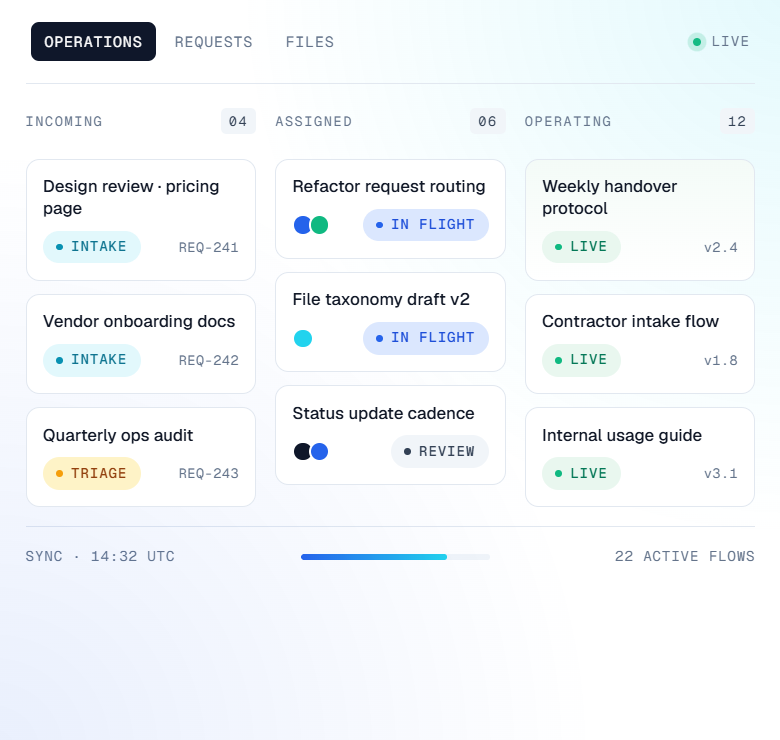
We organize internal requests, task flows, file structures, and status updates into operating systems teams can follow consistently.
ENGAGEMENTS
$1K-$5K+
FRAMEWORKS
$500-$800
PRACTICE
OPERATIONS & WORKFLOW
01. SCOPE
What we structure.
Six operational areas where teams typically lose hours each week to ambiguity and rework.
01
Request Handling
How incoming asks reach the team — intake forms, channels, and routing rules.
02
Task Distribution
Clear ownership for every task, with handoff logic the whole team can follow.
03
File Organization
A strategic logic teams actually use — predictable folders, naming, and access.
04
Status Updates
05
Tool Usage Logic
Each digital tool with a defined role, removing duplicated work across platforms.
06
Internal Guidelines
Plain documentation for recurring workflows — so newcomers ramp without coaching.
02. PROBLEM
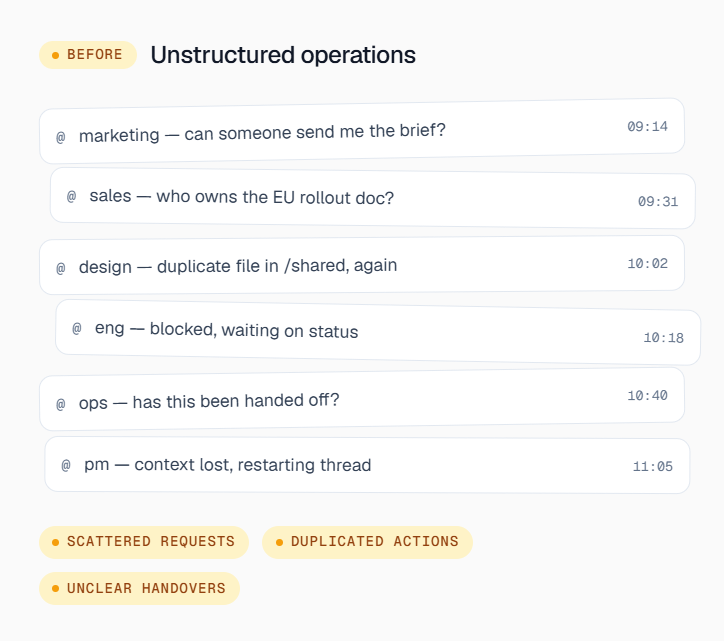
From scattered to structured.
Most operational pain isn't a tool problem — it's a structure problem. Same inputs, same team, different result.


03. APPROACH
A three-stage transformation: examine current state, define the operating logic, and translate it into clear, durable structure.

04. SERVICES
Engagements built around operational depth.
Six core services. Most engagements combine two or three, depending on scope and team size.
SERVICE #01
Workflow Review
SERVICE #02
Process Restructuring
SERVICE #03
Request Flow Design
End-to-end rules for incoming requests; intake, routing, prioritization, and ownership across functions.
SERVICE #04
Task Assignment Logic
Clear distribution rules that match work to the right owner, with documented backup and handoff points.
SERVICE #05
Status Update Procedures
Consistent update structures for projects and recurring operations, replacing fragmented messaging.
SERVICE #06
Ongoing Operational Support
Retainer support as your team grows or your workflows shift — kept current, kept consistent, kept lean.
05. FRAMEWORKS
Ready-made workflow frameworks.
Pre-built structures for teams that want to self-serve. A starting point — not a replacement for full consulting.

Request Handling Framework
Intake form templates, routing logic and priority matrix. For teams that want a faster start.
$540 one-time
Brief →

Task Distribution Structure
Assignment matrices, ownership rules, and
handoff templates for cross-team coordination.
$720 one-time
Brief →

File Organization Logic Kit
Folder taxonomies, naming conventions and
access patterns for shared materials.
$540 one-time
Brief →

Status Update Procedure Pack
Cadence templates and structured update formats for teams and stakeholders.
$550 one-time
Brief →

Internal Workflow Framework
End-to-end framework covering intake, distribution, handoff and archive for one team.
$800 one-time
Brief →

Digital Tool Usage Guide
Documented rule per tool — what's used for what, who owns it, and where things live.
$520 one-time
Brief →
06. ENTERPRISE
Long-running engagements for teams with significant complexity — multiple stakeholders, ongoing change, and operating dependencies that cross departments.
Discuss an engagement →
07. OUTCOMES
What changes for the team.
Outcomes our clients consistently report after a structuring engagement.
01
Clearer operations
Teams know what's happening, who owns it, and where it lives.
02
Less manual coordination
Fewer pings, repeat questions, and reconstructed contexts.
03
Consistent workflows
Recurring work follows one structure across the organization.
04
Scalable internal systems
Operations hold their shape as teams and scope grow.
08. PROCESS
Four steps, from review to running system.
A clear engagement structure, sized to the scope of the work.
STEP 01
Review current workflow
We map how requests, tasks and materials actually move through the team today.
STEP 02
Identify gaps
Duplicated steps, missing handovers and inefficient actions surface against the map.
STEP 03
A documented, repeatable structure that fits how the team genuinely works.
STEP 04
Support implementation
Materials, guidelines, and ongoing support
while the system takes hold.
09. FAQ
Common questions.
A few things engagements typically start with.
ENGAGE
Build clearer internal workflows. Reduce operational confusion.
A short conversation is usually enough to understand whether the fit is right. We respond to every inquiry within two working days.

Premium digital operations consulting and workflow structuring services for businesses that need clearer internal processes, request handling, task distribution, and online tool usage systems.
Ⓒ ORQELYX STRUCTURES